
Save a painful, infected tooth
A root canal treatment removes infected nerve tissue from inside a tooth, relieves the pain and lets you keep your natural tooth. With modern anesthetic it is typically no more uncomfortable than a filling. Bathurst Centre Dental Care provides root canal treatment in Thornhill for patients from Vaughan, Markham, Richmond Hill and North York, with same-day emergency appointments available in most cases.

What is a root canal treatment?
Root canals are the natural channels inside a tooth that contain nerve tissue and blood vessels, otherwise known as dental pulp. When cavities are left untreated, bacteria eventually reach the root canals, causing infection of the dental pulp. A cracked tooth or an injury can also expose the pulp to bacteria.
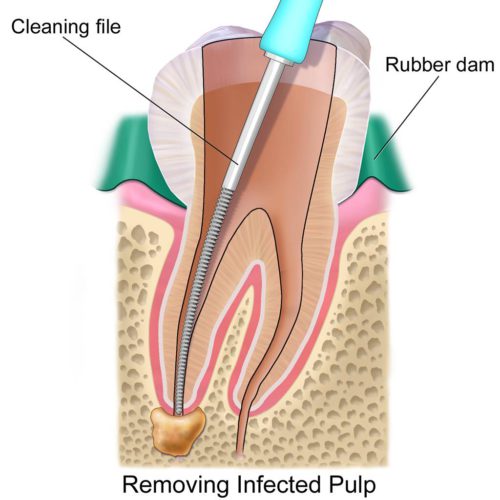
Root canal treatment is the removal of the infected pulp, the shaping, cleaning and disinfection of the canals, and the filling of the cleaned canals with an inert material, all of which eliminate the infection. Root canal treatments often involve the placement of a crown on top of the treated tooth to protect it and restore its natural appearance.
Do I need a root canal treatment?
You may require a root canal treatment if the pulp of your tooth has become infected due to deep tooth decay, a crack or an injury. Common signs include:
Lingering sensitivity
Pain from hot or cold that lasts long after the food or drink is gone.
Pain when chewing
A tooth that hurts when you bite down or touch it.
Swelling or a gum pimple
Swollen gums, or a small bump on the gum that may drain.
A darkened tooth
A tooth that has turned grey or dark compared to its neighbours.
Constant toothache
A throbbing ache that can wake you at night or spread to the jaw and ear.
No symptoms
Some infections are painless and show up only on an X-ray.
Leaving a tooth with an infected pulp untreated can lead to an abscess and the spread of infection into the jaw and surrounding tissues. If you have a toothache, call us for an emergency appointment.
What are the alternatives to a root canal?
The only alternative to root canal treatment is the extraction of the affected tooth. Antibiotics can temporarily keep infection from spreading to surrounding tissues, but will not eliminate the source of the infection, which is the infected pulp tissue inside the canal.
If you choose extraction, the extracted tooth can be replaced with a bridge, denture or implant. Extracting a tooth and not replacing it may lead to other serious issues if your teeth shift over time to fill the gap. Keeping your natural tooth is usually the simpler and less expensive option.
What happens during root canal treatment?
Treatment is usually completed in one or two visits, depending on the tooth and the severity of the infection.
Freezing
The tooth is fully numbed with local anesthetic, the same freezing used for fillings.
Clean the canals
The infected pulp is removed and the canals are cleaned, shaped and disinfected.
Fill and seal
The canals are filled with an inert material and the tooth is sealed with a filling.
Crown
Back teeth usually receive a crown afterwards to protect the tooth from fracture.
Is root canal treatment painful?
Patients are typically given the same anesthetic provided during the treatment of cavities and other dental procedures. This anesthetic completely numbs the affected area, so a root canal treatment is typically no more painful than a standard filling. In fact, most patients come in with a toothache and leave with the pain relieved. The procedure does take longer than a filling and may sometimes require more than one visit depending on the severity of the infection. There is usually some minor tenderness for a few days after the anesthetic wears off that can be easily controlled with over-the-counter pain medication.
Root canal FAQs
Plan on roughly 60 to 90 minutes per visit. Front teeth have one canal and are quicker; molars have three or four canals and may need a second visit. Your dentist will tell you what to expect for your tooth.
Yes. Root canal treatment is done with local anesthetic only, so you can drive and return to your normal activities the same day. If you choose IV sedation for the appointment, you will need someone to drive you home.
Usually, yes, for back teeth. A tooth that has had a root canal is more brittle, and a crown protects it from cracking under chewing forces. Front teeth with little structure lost can sometimes be restored with a filling alone.
With a proper crown and good home care, a root canal treated tooth can last many years, often a lifetime. Regular exams let us check the tooth and the bone around it.
No. Antibiotics can calm the surrounding tissues temporarily, but they cannot reach the dead pulp inside the tooth, so the infection returns. Only a root canal treatment or an extraction removes the source.
Yes. Root canals for severely decayed, infected or broken teeth are a covered endodontic service under the CDCP for eligible patients. Some treatments require preauthorization, which we submit for you. CDCP at our clinic.
Call us at 905-707-8008 and ask for an emergency appointment. Over-the-counter pain relief such as acetaminophen or ibuprofen and a cold compress can help until you are seen. Emergency dental services.
Does my insurance cover root canal treatment?
Most dental plans cover a large portion of root canal treatment, and crowns are often covered under major restorative services. Coverage varies by policy, so we will confirm your plan and provide an estimate before treatment begins.
Portions excerpted from https://en.wikipedia.org/wiki/Endodontic_therapy under the Creative Commons license.



How much does the root canal cost?
Hi Khalil, thank you for your inquiry. The price of root canal treatment varies depending the type of tooth and the number of canals. On average, a molar tooth will have 3-4 canals, but it can have anywhere between 2-6 canals. A front incisor tooth will typically have 1-2 canals. Molar root canal treatments will cost more because of the greater number of canals and more complexities of the treatment. An exam with X-ray is typically needed to help determining the specific pricing. For more information, please contact us at [email protected] or call us at 905-707-8008.
Hey I had a root canal done in August and during end of October and now January I keep have sensitivity on the tooth they did the surgery on and the tooth next to it towards cold things or really sweet food ( like milk chocolate). Would I need to get the root canal redone?
Hi Bea, unfortunately it’s not possible for me to tell you the exact cause of the sensitivity you’re experiencing without a direct examination of your teeth and X-rays and performing some tests. The sensitivity could also be caused by cavities on the teeth next to the root canal treated tooth. You should definitely visit a dentist soon.
Sir I am going to sit for RCT. I have heard that rct may cause infections in future due to filing. Is this true? Is rct safe?
Hi Sara, root canal treatment is a safe and effective procedure for teeth whose pulp has become inflamed or infected. It is a better alternative to tooth extraction in most instances. As with all dental procedures, there is a small but potential risk of failure. Please talk to your dentist regarding your concerns prior to the treatment.
Hello.
I had a root canal procedure finished today. As the freezing has come out I am in the same amount of pain I was in a couple weeks ago before my first appointment. The tooth is 26 I believe, top left, second last molar. The tooth is having vibrating/pulsing feelings in it, as if the tooth is being hit or pulled on. Does this mean the procedure failed??
Hi Kim, it is too early to tell if the root canal treatment is successful or not. It is normal to have some discomfort or some pain right after a root canal treatment; especially if the infection you had was advanced. The pain should get better in a few days, if not please contact your dentist for a followup appointment.
Hi Dr. Qin Li!
I have a RCT scheduled about 5 weeks from now. I started taking antibiotics 3 days ago.
Is it ok to wait this long for a RCT? I’m just worried about the infection spreading, bone loss, or worsening state of the infected tooth in that time span.
Should I find another dentist who can schedule me in earlier?
Thanks.
Hi Lisa,
Without a physical examination, I cannot comment on your specific case. My guess is that your dentist probably doesn’t have an earlier appointment and sees no immediate issue with waiting for 5 weeks. You were probably placed on antibiotics to try to prevent the spread of the infection for that 5 week period.
Typically, if a patient is not in discomfort and there is no swelling of the face/cheek/ gum, then there is likely little danger in waiting for a short period of time. However, if any of the symptoms mentioned above appear and antibiotics are not helping, I would typically recommend starting the treatment earlier. You can asked to be put on a last minute cancellation list at the dental office in case any earlier appointment time opens up. If you are still concerned, ask your dentist if he or she has someone they can refer you to.
I still have numbness in my lips due to anesthesia after i had my root canal procedure 2 days ago
Could you please advise is this is normal and what should i do ?
Hi Mohamed, the loss of sensation in your lip after root canal treatment is called paresthesia. It is an uncommon but potential side effect of root canal treatment. The occurrence of paresthesia in lower premolars after root canal treatment is as low as 0.98% in an article posted in the Journal of Canadian Dental Association (see link below). Most of the time it is a temporary loss of sensation, but may take awhile for the sensation to come back. Occasionally the loss of sensation may be permanent. Please call your dentist and let him/her know of the situation and schedule a post treatment exam as soon as you can.
https://jcda.ca/article/e13