
Why we use digital X-rays
Digital X-rays let your dentist see cavities between the teeth, infections at the root and bone loss that cannot be seen by looking in the mouth, with a fraction of the radiation of old film X-rays. Bathurst Centre Dental Care uses digital dental X-rays at our Thornhill clinic, serving Vaughan, Markham, Richmond Hill and North York.
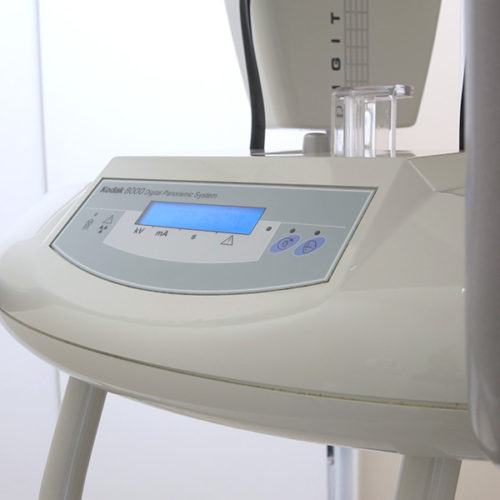
What are the benefits of digital X-rays over traditional film X-rays?
Digital X-rays have numerous benefits over traditional film X-rays, including:
Instant images
Images appear on a computer screen within seconds, so your dentist can review them with you right away.
Reduced radiation
Digital sensors need far less radiation than film to produce a clear image.
Higher detail
Images can be enlarged and enhanced on screen to spot small problems earlier.
Lower environmental impact
No photo processing chemicals, and images can be shared electronically with specialists or your previous dentist.
What types of dental X-rays are there?
Different X-rays show different things. Your dentist chooses the type based on what needs to be checked.
Bitewing
Shows the crowns of the upper and lower back teeth. Used to find cavities between teeth and under fillings.
Periapical
Shows a whole tooth from crown to root tip. Used to check for infection, cracks and bone around a tooth.
Panoramic
One wide image of all the teeth, both jaws and the sinuses. Used for wisdom teeth, implant planning and orthodontic assessments.
Aren't X-rays bad for you?
Dental X-rays result in one of the lowest radiation doses of any medical imaging. Proper shielding and digital sensors make the risk even lower.
of natural background radiation
A routine exam with 4 bitewing exposures is less than one day’s worth of the natural radiation everyone receives.
of flying
About the same radiation as a short airplane flight.
every time
A lead apron and thyroid collar protect the rest of your body.
How often do I need dental X-rays?
X-rays are taken only when they are likely to change your care. The schedule depends on your age, cavity history and gum health.
Bitewings
Routine cavity check for most adults; more often if you get cavities frequently.
Full set or panoramic
A complete baseline, unless recent X-rays can be sent from your previous dentist.
Specific X-rays
For a toothache, injury, root canal, extraction or implant planning.
Dental X-ray FAQs
Dental X-rays are generally considered safe during pregnancy. The dose is very low, the beam is aimed at the mouth, and a lead apron shields your abdomen. Please tell us if you are or may be pregnant, and we will take X-rays only if they are needed for your care.
Yes. We use the smallest number of X-rays needed, child-sized settings and a lead apron. X-rays help us find cavities between baby teeth and check that adult teeth are developing normally. Children’s dentistry.
Yes. Digital images can be emailed securely to a specialist or to your dentist back home with your permission. We can also request recent X-rays from your previous dentist so they do not need to be repeated.
Cavities between teeth and under fillings, infection or abscess at the root tip, bone loss from gum disease, impacted wisdom teeth, cysts and tumours in the jaw, and the position of developing teeth in children.
Many problems, including cavities between teeth and infections at the root, cause no pain until they are advanced. Finding them on an X-ray while they are small means simpler, less expensive treatment.
Yes. X-rays are a covered diagnostic service under the CDCP for eligible patients, within the plan’s frequency limits. CDCP at our clinic.
Are X-rays covered by my insurance?
Coverage will vary from policy to policy, but most plans cover X-rays at regular intervals, usually every 1 to 2 years. We can confirm your plan coverage when you come in for an appointment or free consultation.

should i be concerned about amiunt of radiation fulls series- sept 2019, aug 2018- 4 bitewings, dec 2016- panoramic, oct 2015- 4 bitewings
Hi Carolle,
According to the American Dental Association website, “radiation exposure associated with dentistry represents a minor contribution to the total exposure from all sources, including natural and man-made. The National Council on Radiation Protection and Measurements (NCRP) has estimated that the mean effective radiation dose from all sources in the U.S. is 6.2 millisieverts (mSv) per year, with about half of this dose (i.e., 3.1 mSv) from natural sources (e.g., soil, radon) and about 3.1 mSv from man-made sources.” For intraoral X-rays such as bitewings, the amount of radiation is 0.005 mSv. For a panoramic X-ray, the dose is 0.01 mSv. Please visit this link for more details: https://www.ada.org/en/member-center/oral-health-topics/x-rays